The Ancient Mariner’s curse and penance
The Rime of the Ancient MarinerThe Ancient Mariner’s curse and penance give the killing of the Albatross an afterlife: the act first isolates him from his shipmates and from prayer, then becomes the burden he must repeatedly confess. The bird hung in place of a cross is the visible emblem of his guilt; the Albatross’s eventual fall marks a restoration of prayer, not the end of his obligation. His story joins remorse to an unfinished discipline of witnessing, carried from the ship to the Hermit and onward to the Wedding-Guest.
The killing and its immediate burden
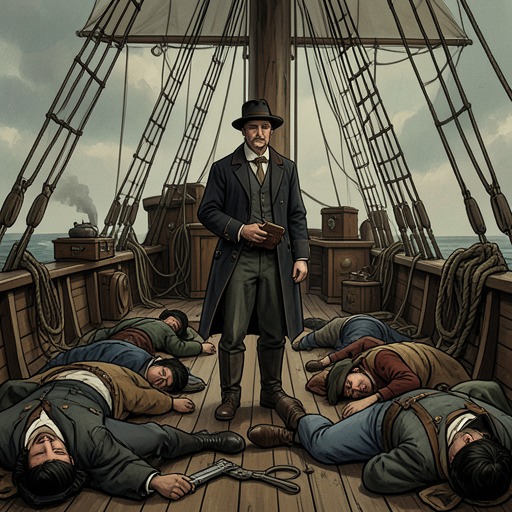
The curse begins with the Ancient Mariner’s own deed. Looking back on it, he calls it an “hellish thing,” while the crew’s judgment is expressed in their repeated assertion that he had killed the bird. Their response changes as circumstances change: at first the killing is condemned, but when the voyage appears to improve, the crew also says that the Ancient Mariner had killed the bird that brought the fog and mist. Their shifting verdict places his guilt within a larger, unstable interpretation of the voyage, without undoing the fact that the killing was his act.
The burden becomes a sign the crew can see. The Albatross is placed around the Ancient Mariner’s neck “Instead of the cross,” joining the image of Christian devotion to the physical mark of the deed that obstructs his return to it. The contrast gives the curse a religious as well as social meaning: the bird is no longer simply part of the voyage’s past, but a sign of the guilt he carries.
Isolation and the loss of prayer
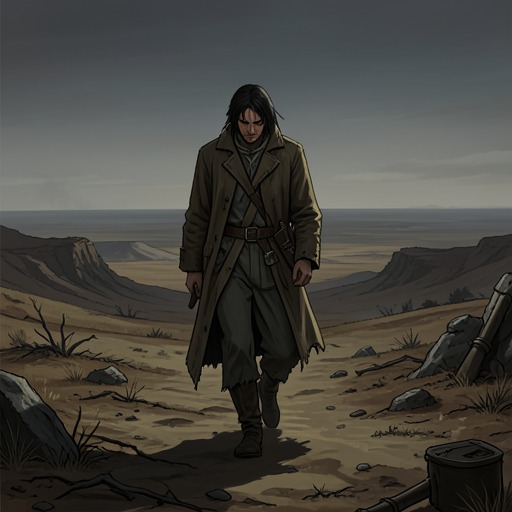
The curse is experienced as estrangement. The Ancient Mariner describes himself as “Alone, alone, all, all alone,” and recalls the look with which the dead crew regarded him. Their gaze continues to weigh on him after their deaths; for seven days and seven nights he sees that curse. The duration makes his solitude a sustained ordeal rather than a passing reaction, while the remembered eyes keep the consequences of the voyage present.
Prayer is also beyond his reach. He looks toward Heaven and tries to pray, but the effort fails. This inability matters because his later recovery is expressed not only as relief but as the return of a spiritual capacity that guilt and isolation had interrupted. The poem does not treat confession and prayer as interchangeable: the Ancient Mariner’s inward change first appears in his spontaneous regard for other life, while his later plea to the Hermit seeks religious absolution.
Blessing and a partial release
A change comes when the Ancient Mariner responds warmly to living creatures, exclaiming, “O happy living things!” At that same moment he can pray again. The sequence links renewed prayer to a change in how he regards other life: rather than treating the creatures as incidental to his own distress, he recognizes them with feeling. The Albatross then falls from his neck and sinks into the sea. Its release answers the earlier image of the bird substituted for a cross, but it does not erase the event or free him from all consequences.
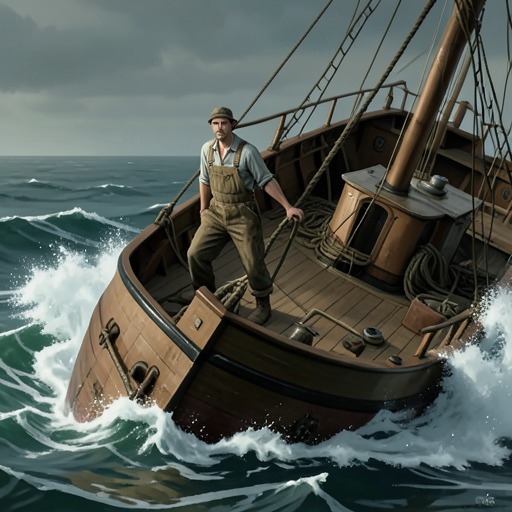
The recovery is framed in religious language. The Ancient Mariner gives praise to Mary Queen, marking the return of prayer as an acknowledged gift rather than simply a change in circumstances. Later, as the vessel moves on under the helmsman’s steering, the voyage continues after this release. The burden has changed form: the visible emblem is gone, but the need to account for the killing remains.
Penance after the voyage
On the return, the Ancient Mariner’s penance is recognized by another person before it is fully explained. Asked whether this is the man, a speaker answers that the Ancient Mariner “hath penance done” and “penance more will do.” The paired statements define his condition as both accomplished suffering and an obligation still in progress. The text offers no final absolution at this point; instead, the prospect of further penance becomes part of how others identify him.
The Ancient Mariner later reaches the Hermit and asks him to shrieve him. The request makes explicit his desire for religious mediation, distinct from the earlier moment when prayer spontaneously returned. Yet the act of telling is not completed once he asks for absolution. His tale must be told, and he explains that his bodily frame is wrenched when the familiar listener appears. The compulsion ties his continuing suffering to the repeated act of confession: narration is not merely a report about penance but one of the forms penance takes.
Compelled telling and the lesson carried onward
The compulsion recurs when the Ancient Mariner sees a face that calls forth the story. He tells the Wedding-Guest, whose presence turns a private burden into a witnessed account. The repeated telling does not make the Ancient Mariner’s experience a single finished episode; each encounter renews the demand to speak, even after the voyage has ended and the Albatross has fallen away.
The tale’s closing moral connects prayer with love: “He prayeth well, who loveth well”. In the arc of the penance, this principle is made concrete by the Ancient Mariner’s renewed capacity to pray after he blesses living creatures. The Wedding-Guest, hearing the account, leaves as a changed man, so the Ancient Mariner’s continuing obligation also has an effect beyond himself. His curse isolates him, but the tale he is compelled to repeat carries its warning to another listener: prayer is bound to love for living things, and the release of one visible burden does not cancel the responsibility created by the original act.